Surface an existing trust lever
We identified that COD was already available on tandiskaala.com but wasn't being promoted anywhere prominent, let alone at the exit moment when hesitation is highest.

An early, 10-day look at how a cash-on-delivery message shown only at exit intent is performing for a $716-AOV appliances store.

Data as of Jul 24, 2026 · live since Jul 14, 2026 (10 days)
1,545
Impressions
10 days live (Jul 14–Jul 24, 2026)
10.94%
Click-Through Rate
169 of 1,545 impressions clicked a CTA
4
Attributed Orders
Orders placed directly on tandiskaala.com
$2,422.22
Attributed Revenue
Revenue tied to those 4 orders
High-ticket e-commerce stores tend to face a specific conversion problem: the more expensive the average order, the more a first-time visitor hesitates before entering payment details on a site they don't already know.
Tandiskaala was seeing this pattern directly. Despite roughly 8,000 monthly sessions, the overall conversion rate stayed low, and a large share of visitors were exiting the site shortly after landing rather than browsing further.
Tandiskaala runs at an average order value of about $716 — high enough that unfamiliar, first-time visitors were hesitant to commit, and many left before getting far into the site.
As average order value rises, the perceived risk of a mistake rises with it. A $20 impulse buy on an unfamiliar site feels low-risk; a $716 order does not.
Tandiskaala isn't yet a widely recognized brand, so we hypothesized visitors were exiting specifically because nothing on the page addressed that hesitation at the moment it peaked — right before they left.
In conversations with the store's team, we learned Tandiskaala already offered cash on delivery (COD) — a payment option that removes most of the financial risk a first-time buyer faces, since payment only happens once the product is in hand. That feature already existed on the site, but it wasn't being communicated at the one moment it mattered most: the moment a visitor was about to leave.
We identified that COD was already available on tandiskaala.com but wasn't being promoted anywhere prominent, let alone at the exit moment when hesitation is highest.
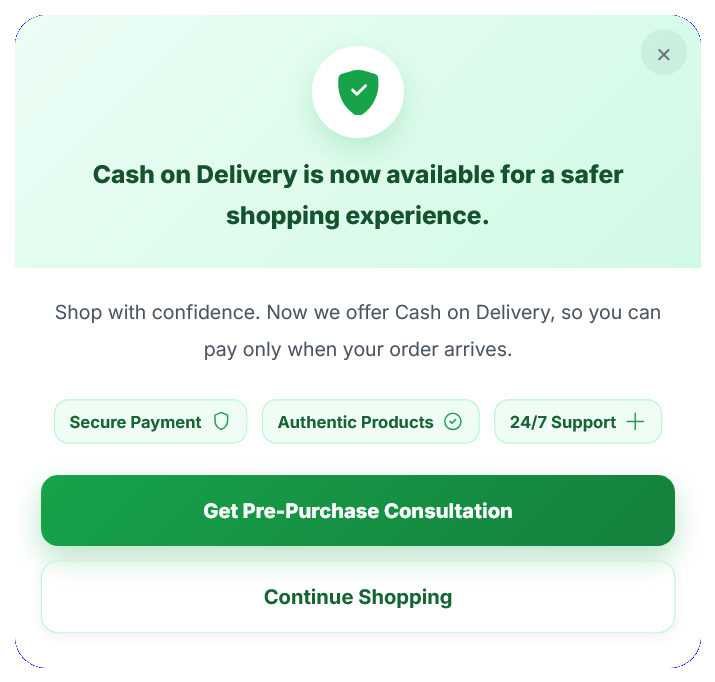
We built a popup, triggered only on exit intent, leading with "Cash on delivery is now available on tandiskaala," backed by a short explanation and two trust badges: secure payment and 24/7 support.
The primary CTA, "Get Pre-Purchase Consultation," connects the visitor directly to the call-center team — a small, low-risk ask. The secondary CTA, "Continue Shopping," simply closes the popup so the visitor can keep browsing and check out on their own.
The popup runs sitewide and only fires on exit intent — it never interrupts active browsing.
A few deliberate choices shaped how this popup tries to earn trust rather than just interrupt the visitor.
Announcing COD availability sitewide would compete with dozens of other messages. Showing it only at exit intent puts it in front of the visitor exactly when hesitation — and the risk of losing the sale — is highest.
The popup uses green, a color commonly associated with safety and reassurance, to visually reinforce the trust message rather than working against it.
The primary CTA asks for a free consultation, not a purchase — a small, low-risk request. Foot-in-the-door research suggests that once someone agrees to a small ask, they become more receptive to a larger one, like placing an order, later on.
Rather than a generic "trusted site" claim, the badges name concrete reassurances — secure payment and 24/7 support — that map directly to the risks a first-time buyer on a high-AOV site is likely weighing.
"Continue Shopping" gives visitors who are already reassured a frictionless way back into their session, instead of forcing every visitor through the consultation path.
This is an early read on a campaign that has only been live for 10 days. The numbers below are attributed to visitors who saw or engaged with the popup, not a causal, controlled measurement.
10.94% (169 of 1,545 impressions)
Clicked a CTA
35.15% (543 of 1,545 impressions)
Closed without clicking
53.91% (833 of 1,545 impressions)
Left without interacting
Commercial outcome
In the first 10 days, 4 orders placed directly on tandiskaala.com are attributed to this popup, totaling $2,422.22 in attributed revenue. Separately, 64 clicks connected visitors to the call-center team; outcomes from those conversations aren't tracked yet.
This campaign hasn't been run as an A/B test against a version of the site without the popup, so we can't claim the popup caused these orders — only that these orders are attributed to visitors who saw or engaged with it.
With only 10 days of data and 4 attributed orders, the campaign needs more time live on the site before these numbers can be treated as statistically stable.
64 visitors clicked "Get Pre-Purchase Consultation" and were connected to the call center, but we don't yet know how many of those conversations converted to a sale or how much revenue they generated.
A longer observation window, a larger order count, and call-center conversion data — ideally alongside an A/B test against a no-popup control — would let us state a causal impact rather than an attributed correlation.
Reveal your existing trust levers at the moment hesitation peaks, not before.
Tandiskaala already had a strong trust lever — COD — sitting unused. If a lift is confirmed with more data, it will likely come less from adding something new and more from surfacing an existing reassurance at the exact moment a high-ticket buyer is deciding whether to leave.
It can help address trust-related hesitation, which tends to be a bigger barrier as order value rises. This example shows early attributed results after 10 days; a longer observation window and a control group would be needed to confirm a causal lift.
Showing a trust message throughout the browsing session risks feeling repetitive or salesy. Reserving it for the moment a visitor is about to leave puts it in front of them exactly when hesitation — and the risk of losing the sale — is highest.
The primary CTA asks for a free pre-purchase consultation rather than a purchase. This is a small, low-risk request; agreeing to it tends to make a person more receptive to a larger request, like placing an order, later on.
Import this exact template or talk to our CRO team about adapting it to your store.